An interview with Pamela H. Smith, Seth Low Professor of History, Distinguished Fellows Faculty Director
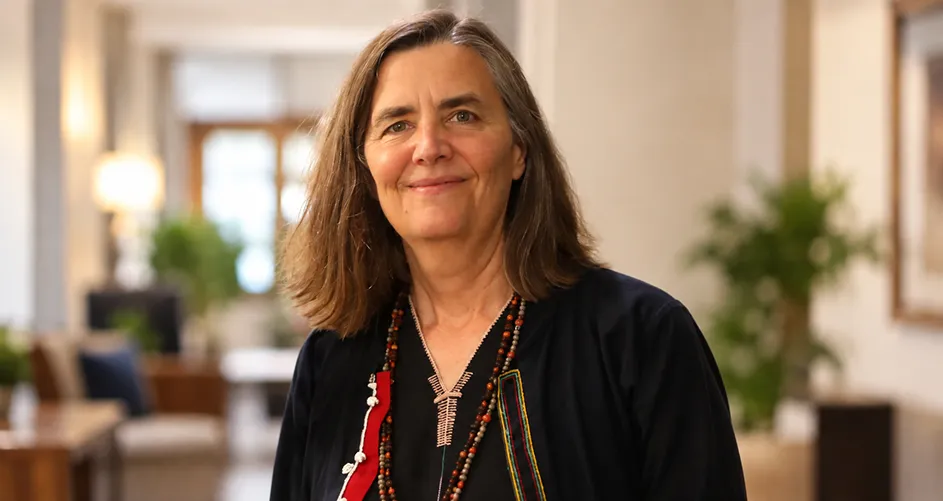
Dr. Smith is the inaugural Faculty Director of the Columbia University Distinguished Fellows Program. In the interview below, she elaborates on her own scholarship and what she hopes to curate in the year ahead.
Your own scholarship explores how people acquire knowledge through both thinking and making. How has that shaped your vision for this program?
I’m a great believer in experiential learning. Traversing a new (or a familiar) landscape, engaging in hands-on creation, from cooking to complex model-building, stimulates both embodied sensory processes and processes of reasoning. In my work, I study the making processes of premodern craftspeople, what I argue are the real progenitors of the so-called scientific revolution. All making—working with the hands—stimulates processes of experimentation trying, changing direction, sometimes failing, extending the inquiry, thinking about what will work, or what to try next.
As one of my 16th-century sources notes, “paper has the property to produce lazy and sleepy people, who are haughty and learn to persuade themselves and to fly without wings… Therefore, the most fundamental thing is to hasten to experience.” What he is saying is still relevant today, that is, although many parts of our education would make one think otherwise, we don’t learn everything from books! This year at Columbia will certainly include much learning from books, but also wide-ranging discussions with new people, exploration of new ideas, and experiencing the vibrant campus of Columbia and the wealth of opportunities in New York City.
What excites you most about teaching and learning with people who bring decades of experience into the classroom?
The individuals who apply to this program will be people who want to learn – this is not just the next step in building a resume or a career, instead, they have chosen to take time from their already busy and successful lives to come back to an environment that will demand of them new and perhaps unaccustomed attention and skills. Making that choice takes intent, courage, and a willingness to be thrust into a new intellectual ecosystem. Moreover, these will be people who have perspectives forged over a lifetime—I’ve always considered the diversity and individuality of people the great compelling mystery of human existence (and of the writing of history or fiction), and I think the individual perspectives of the applicants to this program will be worth getting to know and exploring together.
What does it mean to be intellectually curious at this stage of one’s life—and how might an applicant demonstrate that curiosity?
Do you long for deep and rigorous discussion of hard questions? Are you so stimulated by events, lectures, books, and learning that you wake up in the middle of the night thinking them through further?
Many applicants will have spent decades being experts. What does the program ask of someone who is willing to become a student again?
Fellows will need deep curiosity, love of learning—the feeling of going back to being a student again—tentative, humble, perhaps a little nervous to leave the familiar.
How much freedom will Fellows have to shape their own intellectual journeys, and where will the program provide structure?
The aims of the program include strong cohort building through two curated courses—the Core Journey and the Columbia University Discovery Series—as well as the ability to pursue individual interests through regularly scheduled courses from across the curriculum. Each Fellow will meet with me for a discussion about selecting courses that align with their interests.
Why is it important for seasoned leaders to revisit Columbia’s Core Curriculum of ancient philosophy, literature, and classical texts?
The Core Curriculum is one of the most distinctive and beloved parts of a Columbia education. A particular kind of student chooses to apply and attend Columbia University because of its great books’ curriculum, and those great books are the basis for wide-ranging discussions on both timeless and very timely questions, issues, and controversies. The faculty, too, are educated by teaching the Core Curriculum and its discussions and issues often end up reflected in their research sources and questions. In addition, the result of a common core is that it provides a set of texts, subjects, and questions that students and faculty have in common. They have all discussed the same books and they think with them in other classes, for their written work, and for their lives beyond Columbia. This is a truly remarkable educational experience in the 21st century. If they knew how rare and stimulating an experience it is, anyone should want to be part of this conversation.
How will Fellows engage meaningfully with Columbia faculty and students—not simply attend classes or events?
There will be student-organized and led events for the Fellows, and we hope Fellows will be eager to lead and organize discussions with students. They will learn so much from each other—a perfect opportunity for bi-directional and intergenerational learning.
What do you hope will happen within the cohort itself when people from very different fields and backgrounds learn together?
At the end of the year, I hope the cohort will feel like they’ve had one of the most stimulating intellectual experiences of their lives with like-minded individuals from whom they've gained as much as they've given.
When a Fellow walks off campus at the end of the program, what do you hope they take with them into their next phase of life?
Questions that they will continue to consider and learn from. New passions they have discovered and will pursue further. Good friends and colleagues with whom they will spend time revisiting their Columbia experience. A taste of the incredible riches and ‘human resources’ of Columbia University and New York City.